🚚 Free Worldwide Shipping on All Orders!Shop Now

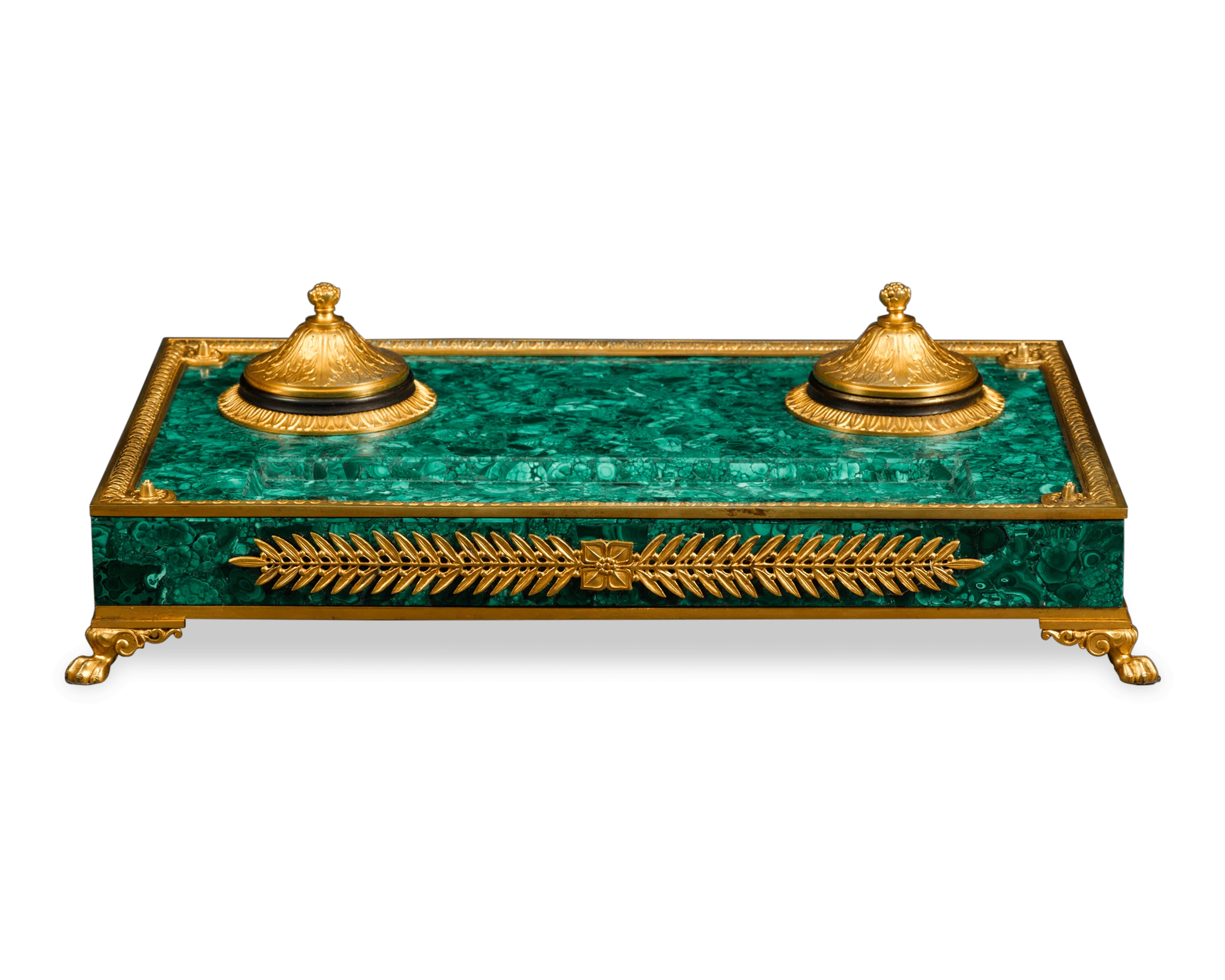


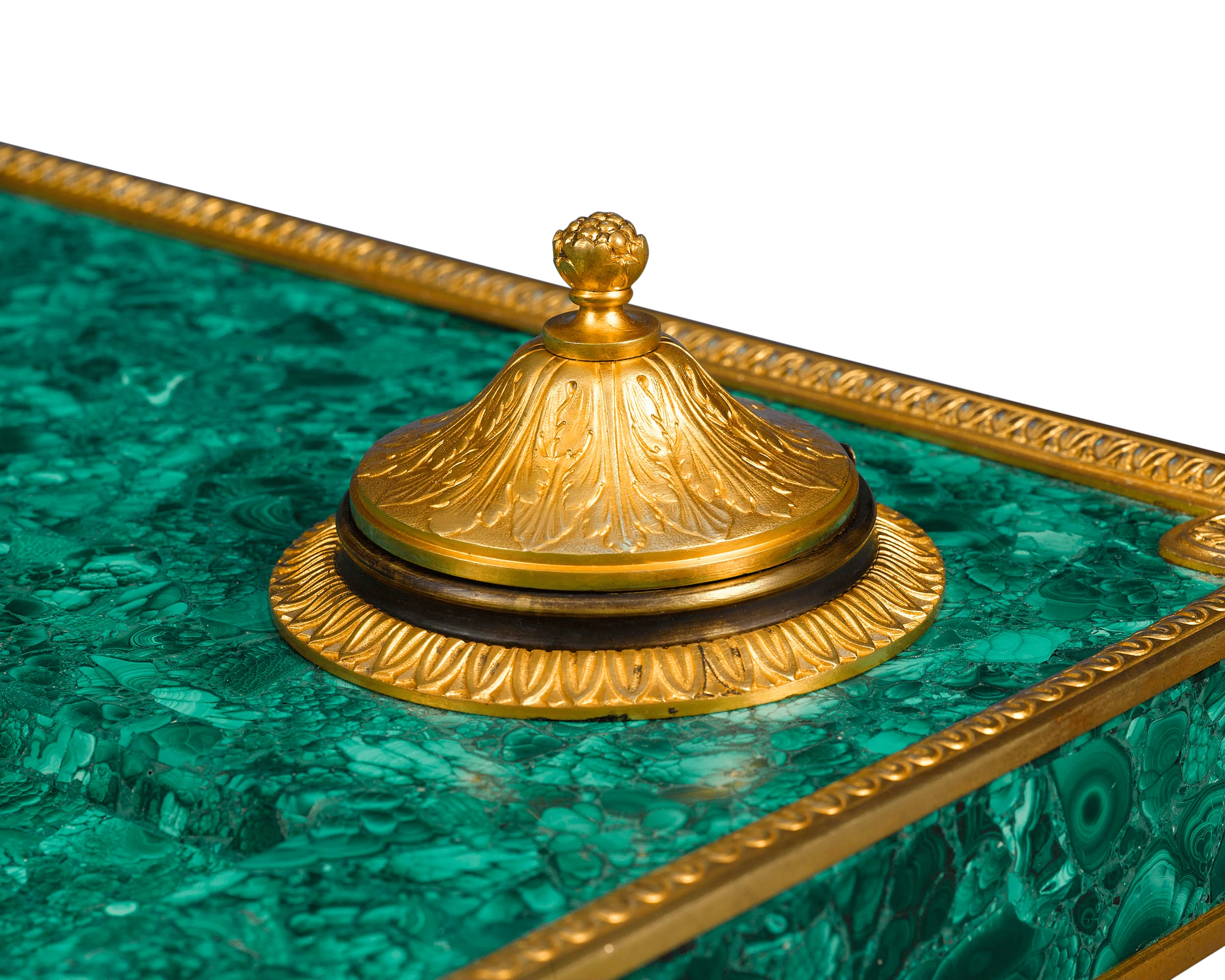
Malachite and Bronze Inkwell
The use of arresting malachite in the creation of this rare and opulent inkwell indicates commission and ownership by an individual of considerable status. Wonderful doré bronze accents are the perfect complement to the vivid green stone. Two dipping wells and pen tray make this inkwell as functional as it is beautiful.
Malachite has long been a sign of prestige and a token of wealth. Found in several locales around the world, the most prosperous source has been the Urals in Russia. So prized was the mineral in the 19th century, Russian papers of the time wrote: “To afford to have a big piece wrought in malachite is synonymous to owning diamonds.” Due to malachite's relatively close proximity, Russian tsars could easily obtain the malachite they needed to decorate their lavish palaces, such as the Winter Palace in St. Petersburg, paneling walls and commissioning beautiful inlaid works of art. Year after year the Russian (Romanov) treasury paid increasingly unreasonable prices to hoard the best malachite, much of which went into Romanov palaces and extravagant objects d’art. The Hermitage Museum possesses a collection of over two hundred examples of this “palatial” malachite, displayed namely in the legendary Malachite Room.
Stamped "AUSTRIA"
Circa 1890
18 1/4” wide x 11” deep x 5 1/2” high
Malachite has long been a sign of prestige and a token of wealth. Found in several locales around the world, the most prosperous source has been the Urals in Russia. So prized was the mineral in the 19th century, Russian papers of the time wrote: “To afford to have a big piece wrought in malachite is synonymous to owning diamonds.” Due to malachite's relatively close proximity, Russian tsars could easily obtain the malachite they needed to decorate their lavish palaces, such as the Winter Palace in St. Petersburg, paneling walls and commissioning beautiful inlaid works of art. Year after year the Russian (Romanov) treasury paid increasingly unreasonable prices to hoard the best malachite, much of which went into Romanov palaces and extravagant objects d’art. The Hermitage Museum possesses a collection of over two hundred examples of this “palatial” malachite, displayed namely in the legendary Malachite Room.
Stamped "AUSTRIA"
Circa 1890
18 1/4” wide x 11” deep x 5 1/2” high
$24,850.00
Malachite and Bronze Inkwell—
$24,850.00
Product Information
Product Information
Shipping & Returns
Shipping & Returns
Description
The use of arresting malachite in the creation of this rare and opulent inkwell indicates commission and ownership by an individual of considerable status. Wonderful doré bronze accents are the perfect complement to the vivid green stone. Two dipping wells and pen tray make this inkwell as functional as it is beautiful.
Malachite has long been a sign of prestige and a token of wealth. Found in several locales around the world, the most prosperous source has been the Urals in Russia. So prized was the mineral in the 19th century, Russian papers of the time wrote: “To afford to have a big piece wrought in malachite is synonymous to owning diamonds.” Due to malachite's relatively close proximity, Russian tsars could easily obtain the malachite they needed to decorate their lavish palaces, such as the Winter Palace in St. Petersburg, paneling walls and commissioning beautiful inlaid works of art. Year after year the Russian (Romanov) treasury paid increasingly unreasonable prices to hoard the best malachite, much of which went into Romanov palaces and extravagant objects d’art. The Hermitage Museum possesses a collection of over two hundred examples of this “palatial” malachite, displayed namely in the legendary Malachite Room.
Stamped "AUSTRIA"
Circa 1890
18 1/4” wide x 11” deep x 5 1/2” high
Malachite has long been a sign of prestige and a token of wealth. Found in several locales around the world, the most prosperous source has been the Urals in Russia. So prized was the mineral in the 19th century, Russian papers of the time wrote: “To afford to have a big piece wrought in malachite is synonymous to owning diamonds.” Due to malachite's relatively close proximity, Russian tsars could easily obtain the malachite they needed to decorate their lavish palaces, such as the Winter Palace in St. Petersburg, paneling walls and commissioning beautiful inlaid works of art. Year after year the Russian (Romanov) treasury paid increasingly unreasonable prices to hoard the best malachite, much of which went into Romanov palaces and extravagant objects d’art. The Hermitage Museum possesses a collection of over two hundred examples of this “palatial” malachite, displayed namely in the legendary Malachite Room.
Stamped "AUSTRIA"
Circa 1890
18 1/4” wide x 11” deep x 5 1/2” high