🚚 Free Worldwide Shipping on All Orders!Shop Now


C'est Pourtant Bien Moi by Arthur Szyk
Arthur Szyk
1894-1951 | Polish
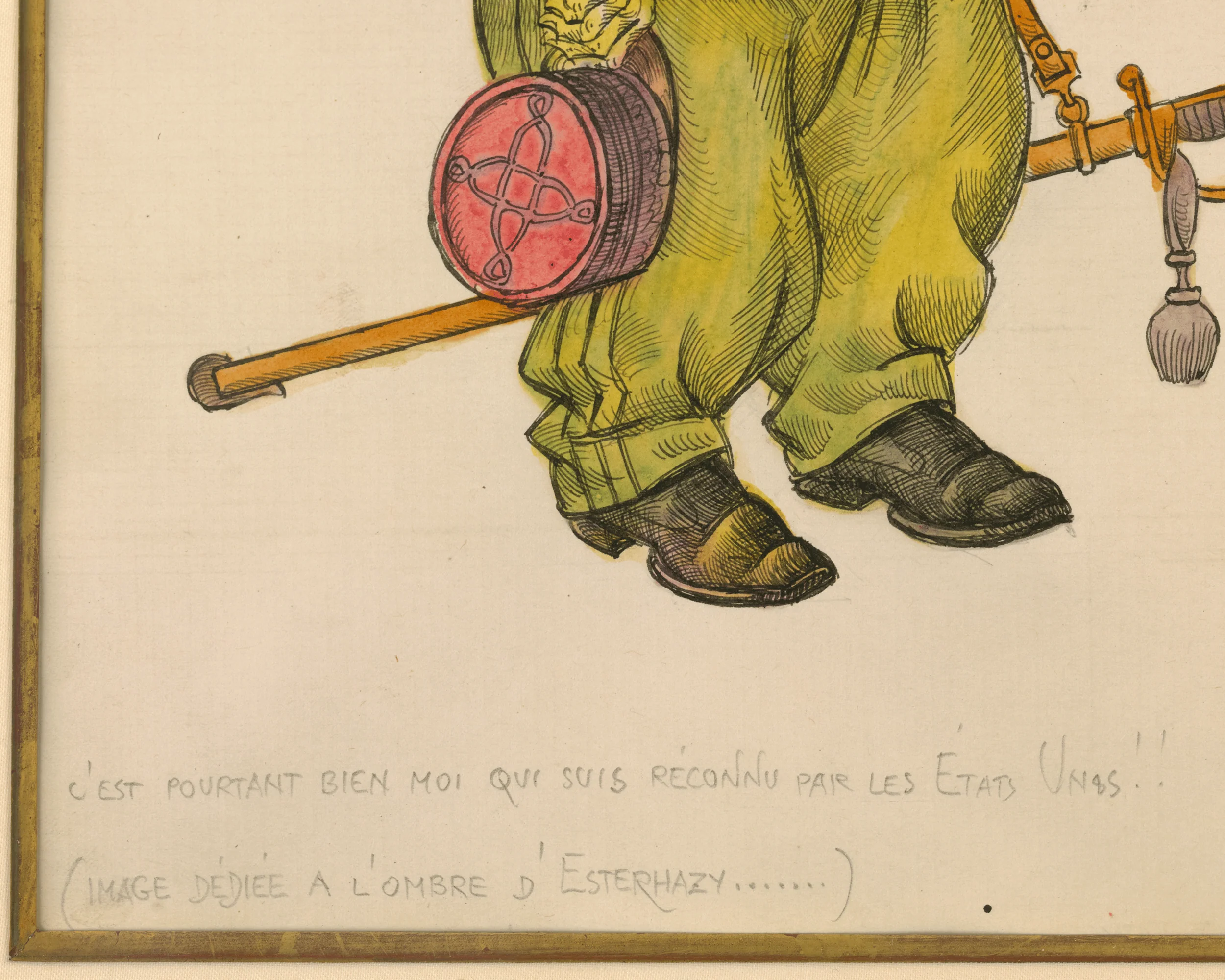
C'est pourtant bien moi qui suis reconnu par les États-Unis!
(It is nevertheless I who am recognized by the United States!)
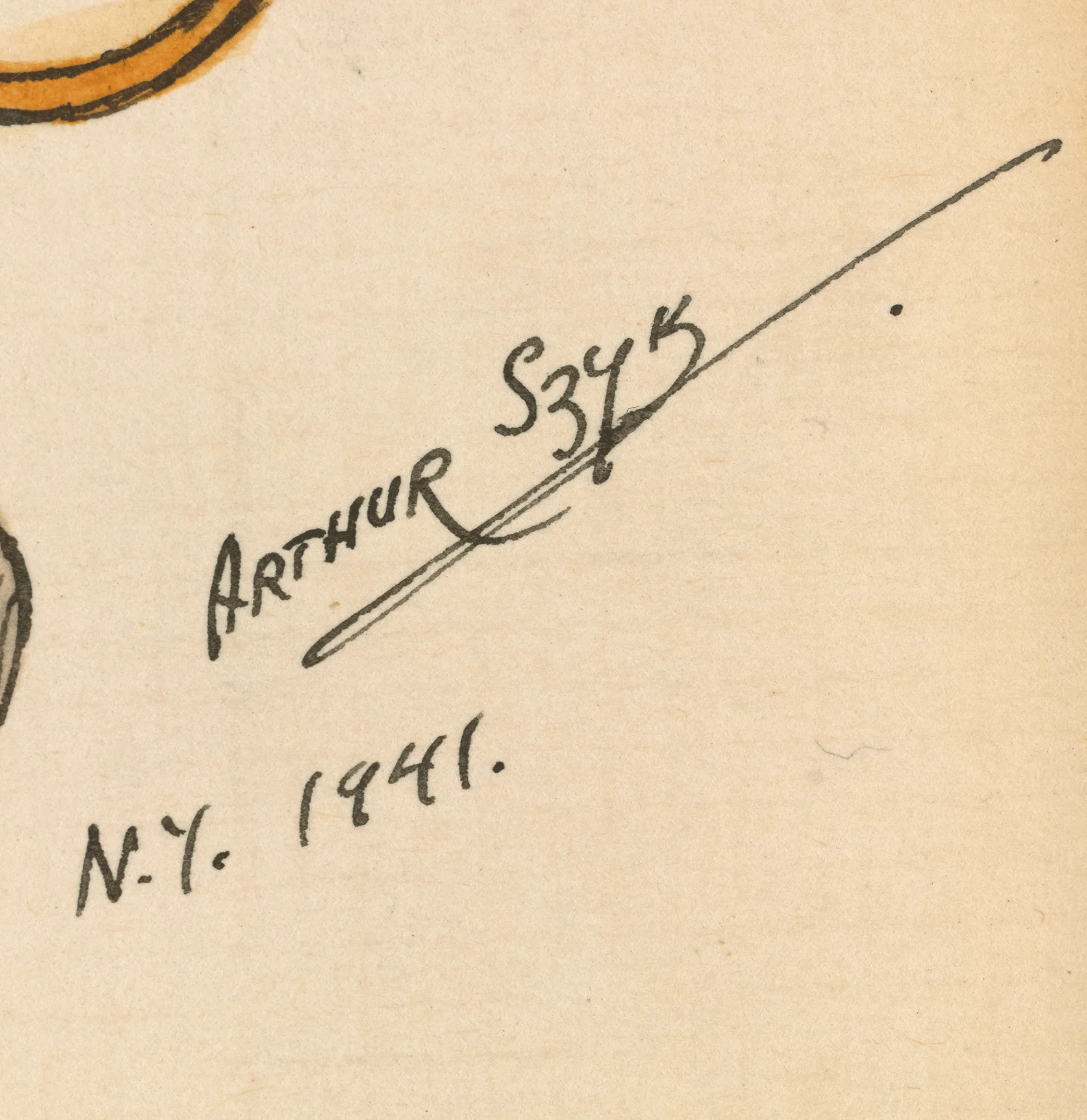
Signed and dated “Arthur Szyk / N.Y. 1941” (lower right)
Pen ink, pencil and watercolor on paper
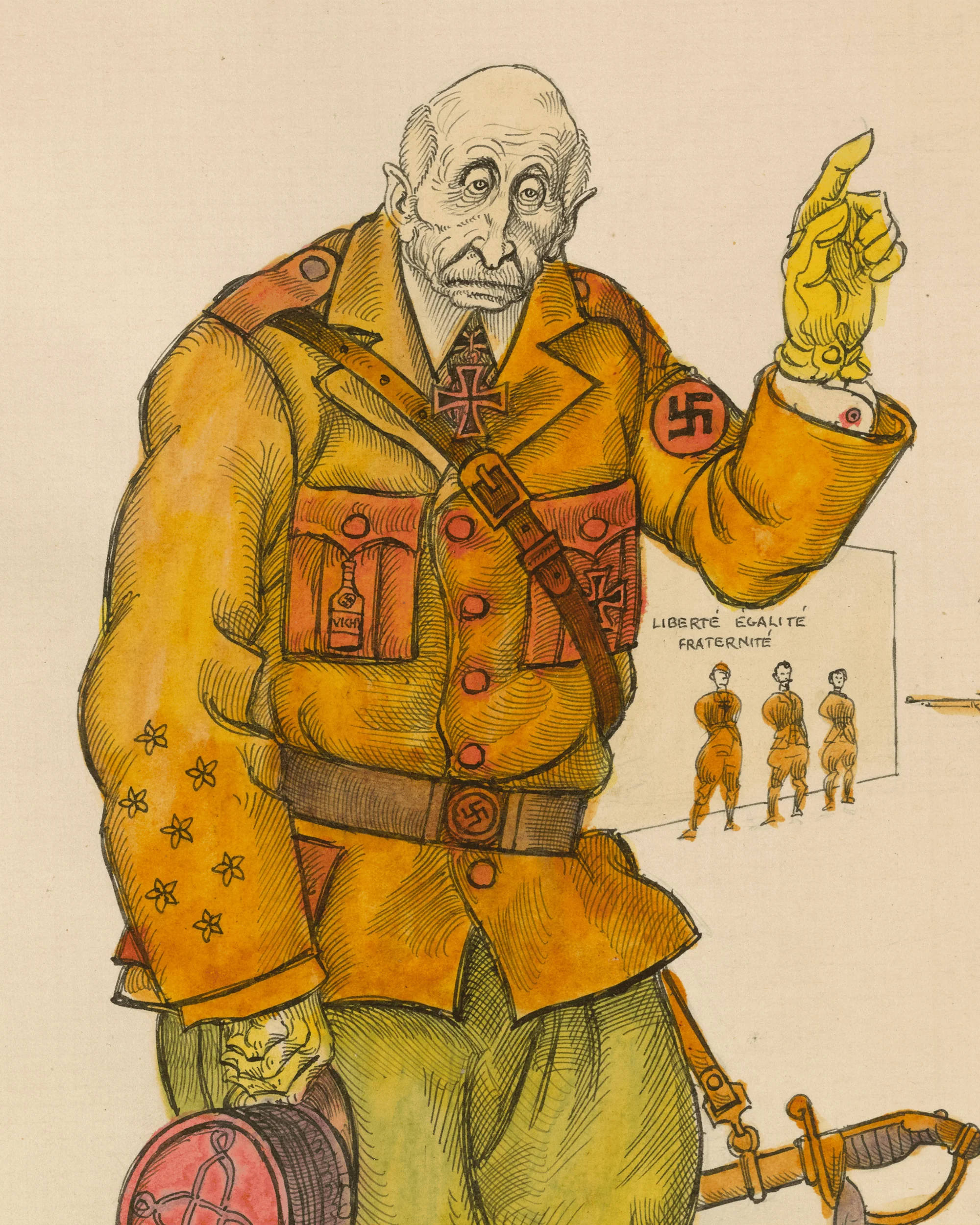
A powerful example of political satire, this World War II-era illustration of Henri Petain, head of the Vichy government in France, was composed by the legendary Arthur Szyk. The Polish-born artist is renowned for his political illustrations, which helped to raise public awareness of Nazi tyranny in the 1940s. His straightforward compositions and political messages made him a favorite of American readers, and his anti-fascist cartoons appeared frequently inside and on the covers of publications such as Esquire, Life, Time and Collier’s.
This work exemplifies Szyk's bold, no-holds-barred style. The subject is an aged Henri Petain, a former World War I hero who became the leader of the collaborationist Vichy regime in France. Petain was a frequent target of Szyk—he depicts the leader here fully bedecked in a Nazi uniform, ordering the deaths of his fellow countrymen in front of a wall sardonically marked with France's national motto, “Liberté. Égalité. Fraternité.”
Szyk also implicates the United States in the work, in a caption that reads: “C'est pourtant bien moi qui suis reconnu par les États-Unis!” (“It is nevertheless I who am recognized by the United States!”). The United States government recognized and practiced diplomatic communications with Vichy France from 1940-1942—a relationship which Szyk openly challenged in this forceful work. The caption further reads, “Image dédiée a l'ombre d'Esterhazy” (“Image dedicated to the shadow of Esterhazy”), equating Petain’s betrayal of his people to that of Ferdinand Walsin Esterhazy—the spy for the German Empire who committed the act of treason for which Captain Alfred Dreyfus was blamed in 1894.
Historically significant and powerfully composed, this work embodies Szyk's unwavering commitment to ending fascism worldwide. Born in Poland in 1894, Szyk was a European Jew who suffered under both the Bolsheviks and the Nazi regimes. His mother and brother were killed by Nazi soldiers in the Polish ghettos, which helped to fuel his anti-fascist artwork. After Germany invaded Poland in 1939, he turned his attention to his cartoons, which helped to engage the American public in the conflicts abroad. The majority of Szyk's works now reside in the Taube Family Arthur Szyk Collection at the University of California, Berkely, and recent major exhibitions at institutions such as the United States Holocaust Museum and the New York Historical Society prove his works are just as powerful today.
Dated 1941
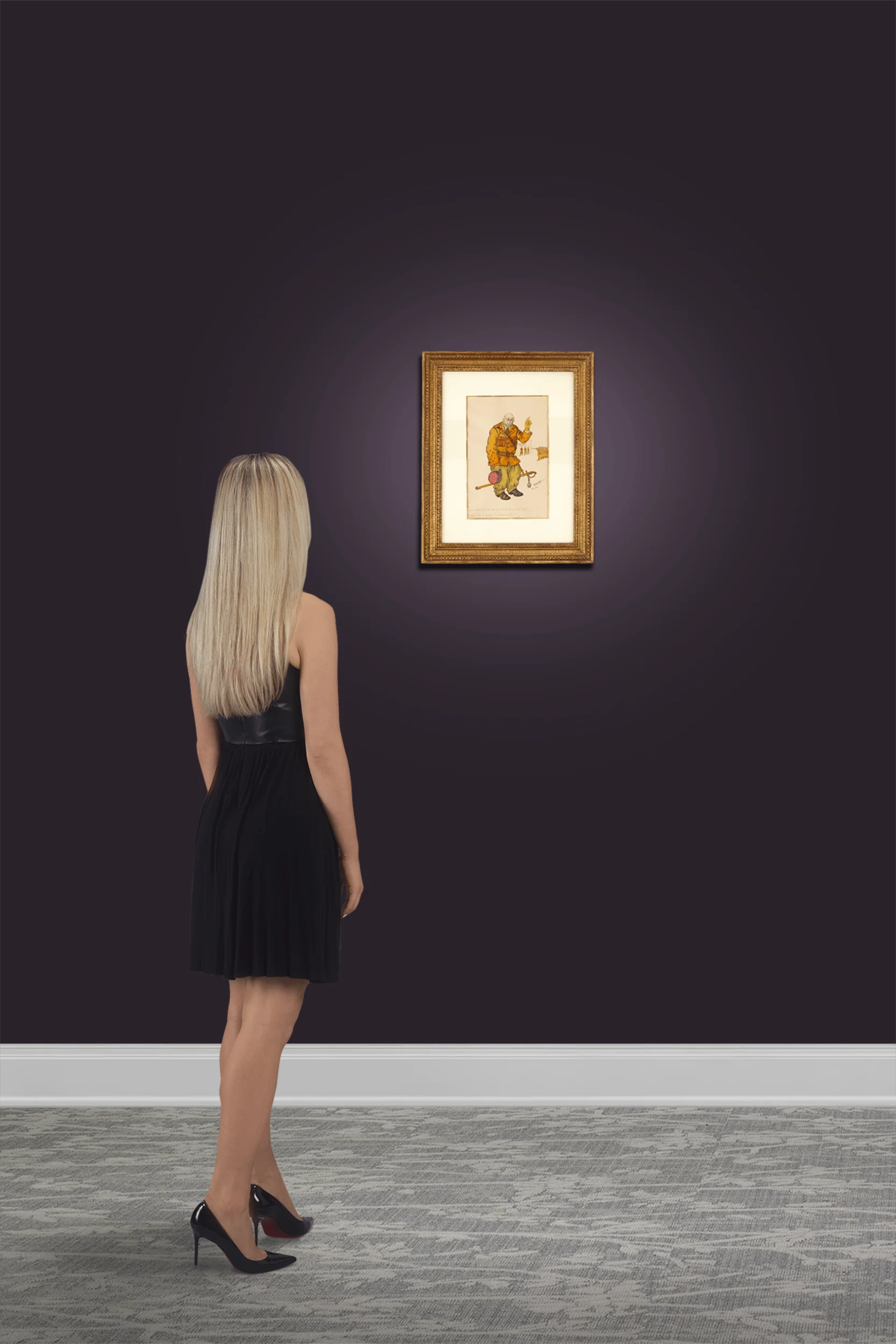
Paper: 10 3/4” high x 7 1/4” wide (27.3 x 17.8 cm)
Frame: 18 3/4” high x 15 1/4” wide 1 3/8" deep (47.6 x 38.7 x 3.4 cm)
Provenance:
Private collection, New York
M.S. Rau, New Orleans
Private collection, United States
M.S. Rau, New Orleans
1894-1951 | Polish
C'est pourtant bien moi qui suis reconnu par les États-Unis!
(It is nevertheless I who am recognized by the United States!)
Signed and dated “Arthur Szyk / N.Y. 1941” (lower right)
Pen ink, pencil and watercolor on paper
A powerful example of political satire, this World War II-era illustration of Henri Petain, head of the Vichy government in France, was composed by the legendary Arthur Szyk. The Polish-born artist is renowned for his political illustrations, which helped to raise public awareness of Nazi tyranny in the 1940s. His straightforward compositions and political messages made him a favorite of American readers, and his anti-fascist cartoons appeared frequently inside and on the covers of publications such as Esquire, Life, Time and Collier’s.
This work exemplifies Szyk's bold, no-holds-barred style. The subject is an aged Henri Petain, a former World War I hero who became the leader of the collaborationist Vichy regime in France. Petain was a frequent target of Szyk—he depicts the leader here fully bedecked in a Nazi uniform, ordering the deaths of his fellow countrymen in front of a wall sardonically marked with France's national motto, “Liberté. Égalité. Fraternité.”
Szyk also implicates the United States in the work, in a caption that reads: “C'est pourtant bien moi qui suis reconnu par les États-Unis!” (“It is nevertheless I who am recognized by the United States!”). The United States government recognized and practiced diplomatic communications with Vichy France from 1940-1942—a relationship which Szyk openly challenged in this forceful work. The caption further reads, “Image dédiée a l'ombre d'Esterhazy” (“Image dedicated to the shadow of Esterhazy”), equating Petain’s betrayal of his people to that of Ferdinand Walsin Esterhazy—the spy for the German Empire who committed the act of treason for which Captain Alfred Dreyfus was blamed in 1894.
Historically significant and powerfully composed, this work embodies Szyk's unwavering commitment to ending fascism worldwide. Born in Poland in 1894, Szyk was a European Jew who suffered under both the Bolsheviks and the Nazi regimes. His mother and brother were killed by Nazi soldiers in the Polish ghettos, which helped to fuel his anti-fascist artwork. After Germany invaded Poland in 1939, he turned his attention to his cartoons, which helped to engage the American public in the conflicts abroad. The majority of Szyk's works now reside in the Taube Family Arthur Szyk Collection at the University of California, Berkely, and recent major exhibitions at institutions such as the United States Holocaust Museum and the New York Historical Society prove his works are just as powerful today.
Dated 1941
Paper: 10 3/4” high x 7 1/4” wide (27.3 x 17.8 cm)
Frame: 18 3/4” high x 15 1/4” wide 1 3/8" deep (47.6 x 38.7 x 3.4 cm)
Provenance:
Private collection, New York
M.S. Rau, New Orleans
Private collection, United States
M.S. Rau, New Orleans
$29,850.00
C'est Pourtant Bien Moi by Arthur Szyk—
$29,850.00
Product Information
Product Information
Shipping & Returns
Shipping & Returns
Description
Arthur Szyk
1894-1951 | Polish
C'est pourtant bien moi qui suis reconnu par les États-Unis!
(It is nevertheless I who am recognized by the United States!)
Signed and dated “Arthur Szyk / N.Y. 1941” (lower right)
Pen ink, pencil and watercolor on paper
A powerful example of political satire, this World War II-era illustration of Henri Petain, head of the Vichy government in France, was composed by the legendary Arthur Szyk. The Polish-born artist is renowned for his political illustrations, which helped to raise public awareness of Nazi tyranny in the 1940s. His straightforward compositions and political messages made him a favorite of American readers, and his anti-fascist cartoons appeared frequently inside and on the covers of publications such as Esquire, Life, Time and Collier’s.
This work exemplifies Szyk's bold, no-holds-barred style. The subject is an aged Henri Petain, a former World War I hero who became the leader of the collaborationist Vichy regime in France. Petain was a frequent target of Szyk—he depicts the leader here fully bedecked in a Nazi uniform, ordering the deaths of his fellow countrymen in front of a wall sardonically marked with France's national motto, “Liberté. Égalité. Fraternité.”
Szyk also implicates the United States in the work, in a caption that reads: “C'est pourtant bien moi qui suis reconnu par les États-Unis!” (“It is nevertheless I who am recognized by the United States!”). The United States government recognized and practiced diplomatic communications with Vichy France from 1940-1942—a relationship which Szyk openly challenged in this forceful work. The caption further reads, “Image dédiée a l'ombre d'Esterhazy” (“Image dedicated to the shadow of Esterhazy”), equating Petain’s betrayal of his people to that of Ferdinand Walsin Esterhazy—the spy for the German Empire who committed the act of treason for which Captain Alfred Dreyfus was blamed in 1894.
Historically significant and powerfully composed, this work embodies Szyk's unwavering commitment to ending fascism worldwide. Born in Poland in 1894, Szyk was a European Jew who suffered under both the Bolsheviks and the Nazi regimes. His mother and brother were killed by Nazi soldiers in the Polish ghettos, which helped to fuel his anti-fascist artwork. After Germany invaded Poland in 1939, he turned his attention to his cartoons, which helped to engage the American public in the conflicts abroad. The majority of Szyk's works now reside in the Taube Family Arthur Szyk Collection at the University of California, Berkely, and recent major exhibitions at institutions such as the United States Holocaust Museum and the New York Historical Society prove his works are just as powerful today.
Dated 1941
Paper: 10 3/4” high x 7 1/4” wide (27.3 x 17.8 cm)
Frame: 18 3/4” high x 15 1/4” wide 1 3/8" deep (47.6 x 38.7 x 3.4 cm)
Provenance:
Private collection, New York
M.S. Rau, New Orleans
Private collection, United States
M.S. Rau, New Orleans
1894-1951 | Polish
C'est pourtant bien moi qui suis reconnu par les États-Unis!
(It is nevertheless I who am recognized by the United States!)
Signed and dated “Arthur Szyk / N.Y. 1941” (lower right)
Pen ink, pencil and watercolor on paper
A powerful example of political satire, this World War II-era illustration of Henri Petain, head of the Vichy government in France, was composed by the legendary Arthur Szyk. The Polish-born artist is renowned for his political illustrations, which helped to raise public awareness of Nazi tyranny in the 1940s. His straightforward compositions and political messages made him a favorite of American readers, and his anti-fascist cartoons appeared frequently inside and on the covers of publications such as Esquire, Life, Time and Collier’s.
This work exemplifies Szyk's bold, no-holds-barred style. The subject is an aged Henri Petain, a former World War I hero who became the leader of the collaborationist Vichy regime in France. Petain was a frequent target of Szyk—he depicts the leader here fully bedecked in a Nazi uniform, ordering the deaths of his fellow countrymen in front of a wall sardonically marked with France's national motto, “Liberté. Égalité. Fraternité.”
Szyk also implicates the United States in the work, in a caption that reads: “C'est pourtant bien moi qui suis reconnu par les États-Unis!” (“It is nevertheless I who am recognized by the United States!”). The United States government recognized and practiced diplomatic communications with Vichy France from 1940-1942—a relationship which Szyk openly challenged in this forceful work. The caption further reads, “Image dédiée a l'ombre d'Esterhazy” (“Image dedicated to the shadow of Esterhazy”), equating Petain’s betrayal of his people to that of Ferdinand Walsin Esterhazy—the spy for the German Empire who committed the act of treason for which Captain Alfred Dreyfus was blamed in 1894.
Historically significant and powerfully composed, this work embodies Szyk's unwavering commitment to ending fascism worldwide. Born in Poland in 1894, Szyk was a European Jew who suffered under both the Bolsheviks and the Nazi regimes. His mother and brother were killed by Nazi soldiers in the Polish ghettos, which helped to fuel his anti-fascist artwork. After Germany invaded Poland in 1939, he turned his attention to his cartoons, which helped to engage the American public in the conflicts abroad. The majority of Szyk's works now reside in the Taube Family Arthur Szyk Collection at the University of California, Berkely, and recent major exhibitions at institutions such as the United States Holocaust Museum and the New York Historical Society prove his works are just as powerful today.
Dated 1941
Paper: 10 3/4” high x 7 1/4” wide (27.3 x 17.8 cm)
Frame: 18 3/4” high x 15 1/4” wide 1 3/8" deep (47.6 x 38.7 x 3.4 cm)
Provenance:
Private collection, New York
M.S. Rau, New Orleans
Private collection, United States
M.S. Rau, New Orleans